
Work on microorganisms from Brazilian mangrove forests receives two prizes at event
The researcher Raissa Ferreira Gutierrez, a researcher at the Brazilian Center for Research in Energy and Materials (CNPEM), received two awards during the 2nd Brazilian Industrial Biotechnology Congress, which was held August 16–19. Her paper entitled “From Mangrove Biodiversity to Biofuel: Mining Brazilian Microbiomes for Hydrocarbon Enzymes” earned Best Oral Presentation in the area of industrial enzymology, and also won first place overall among all the projects presented at the event.
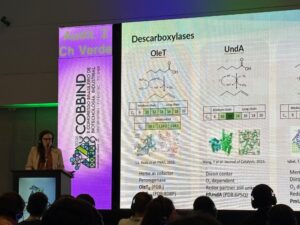
The article, which was coauthored by CNPEM researchers Raquel de Sousa Paredes, Joaquim Martins Jr, Naiara Sampaio, Wesley Generoso, Gabriela F. Persinoti and Letícia Zanphorlin, explored the microbial diversity of mangrove forests in Pernambuco in search of enzymes with potential applications in sustainable production of hydrocarbons. By cultivating and sequencing these microorganisms, the researchers identified new candidate UndA-family decarboxylases, which are able to convert fatty acids into olefins.
One of the analyzed enzymes stood out for being able to convert oleic acid, which is present in various natural oils. Its three-dimensional structure was determined using X-ray diffraction with data collected from the Manacá beamline at Sirius, which made it possible to investigate characteristics of the active site relative to how the enzyme functions.
The resulting olefins could be used as precursors to biofuels, including molecules that may be useful in developing sustainable aviation fuel (SAF) as well as applications in manufacturing lubricants, polymers and other renewable chemicals.
The research utilized the infrastructure in several CNPEM laboratories including Integrated Omics, HT-Biosys, Molecular Chemistry and the Robolab, as well as the Manacá beamline at Sirius. The study highlights the potential of Brazil’s biodiversity in discovering new biotechnology solutions and developing alternatives to raw materials from fossil sources.
Sobre o CNPEM
O Centro Nacional de Pesquisa em Energia e Materiais (CNPEM) abriga um ambiente científico de fronteira, multiusuário e multidisciplinar, com ações em diferentes frentes do Sistema Nacional de CT&I. Organização Social supervisionada pelo Ministério da Ciência, Tecnologia e Inovação (MCTI), com interveniência do Ministério da Educação e do Ministério da Saúde, o CNPEM é impulsionado por pesquisas que impactam as áreas de saúde, energia, materiais renováveis e sustentabilidade. Responsável pelo Sirius, maior equipamento científico já construído no País. O CNPEM hoje desenvolve o projeto Orion, complexo laboratorial para pesquisas avançadas em patógenos. Equipes altamente especializadas em ciência e engenharia, infraestruturas sofisticadas abertas à comunidade científica, linhas estratégicas de investigação, projetos inovadores com o setor produtivo e formação de pesquisadores e estudantes compõem os pilares da atuação deste centro único no País, capaz de atuar como ponte entre conhecimento e inovação. As atividades de pesquisa e desenvolvimento do CNPEM são realizadas por seus Laboratórios Nacionais de: Luz Síncrotron (LNLS), Biociências (LNBio), Nanotecnologia (LNNano) e Biorrenováveis (LNBR), além de sua unidade de Tecnologia (DAT) e da Ilum Escola de Ciência, curso de bacharelado em Ciência e Tecnologia.