
Leticia Zanphorlin develops research with enzymes to transform agro-industrial waste into advanced fuels and renewable chemicals
Researcher Leticia Maria Zanphorlin Murakami, from the Brazilian Center for Research in Energy and Materials (CNPEM), was selected by Forbes Brasil magazine as one of the “100 Powerful Women in Agribusiness”. The list, published on October 15, brings together female rural producers, researchers, executives, entrepreneurs, and institutional leaders, considering their decision-making power, impact, and influence in the sector.
At CNPEM, Leticia leads a research group dedicated to the use of agro-industrial waste for the sustainable production of advanced fuels, renewable chemicals, and vitamins. The work, developed at the Center’s Biorenewables Unit, involves the study and engineering of enzymes, proteins that accelerate chemical reactions, to develop processes for transforming these raw materials into products with greater added value.
“I received the news with great surprise and emotion. I didn’t know I had been selected and only found out my name when I saw the list published by Forbes. For me, this achievement has a particularly special meaning because it highlights the potential of science and biotechnology in transforming agribusiness”, says Leticia.

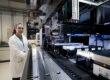
Letícia Zanphorlin em atividade no CNPEM
In the researcher’s profile, Forbes highlights the development of enzymes capable of transforming fats and agro-industrial waste into hydrocarbons, compounds that can be used in the production of sustainable aviation fuel and renewable chemicals. The publication also mentions partnerships with companies and patents resulting from the research.
Holder of a bachelor’s degree in Physics and a master’s degree in Molecular Biophysics from São Paulo State University (Unesp), Letícia also holds a PhD in Chemistry from the State University of Campinas (Unicamp). She has been working as a group leader at CNPEM since 2019 and is also a collaborating researcher at Unicamp, linked to two graduate programs.
At CNPEM, Zanphorlin coordinates research projects in partnership with national and international companies. Her scientific production includes publications and patent applications in Brazil and abroad. Currently, she represents the Center in the Global Bioeconomy Alliance (GBA) and is an associate editor of the scientific journal npj Biocatalysis.
In commenting on the recognition, the researcher highlights the participation of students, researchers, collaborators, and partners in her journey, as well as the research environment provided by CNPEM. “Science is a collective endeavor, and no result would be possible without the work, dedication, and talent of the people I have the privilege of working with”, she says.
This is the second edition of the “100 Powerful Women in Agribusiness” list, originally launched in 2021. For Letícia, giving visibility to women in science helps to recognize their contributions, broaden their perspectives, and show new generations that these spaces also belong to them. “For a long time, science, technology, and industrial sectors were predominantly associated with male trajectories. Recognizing women who hold leadership positions in these areas helps to transform this perception, break down stereotypes, and inspire other women and girls to follow their own paths”, she says.
The researcher also highlights the role of leadership in training new scientists. “Throughout my career, I have also learned that leadership is much more than achieving scientific results. It’s about training people, creating opportunities, encouraging autonomy, and helping other researchers develop their full potential”, she says.
The mother of Maria Clara, 10 years old, Letícia emphasizes that the recognition takes on a personal dimension. “I want my daughter to grow up knowing that she can make her own choices, pursue her dreams, and occupy the spaces she desires. I strongly believe in the power of example and the importance of showing, through real-life stories, that women can be protagonists in knowledge creation, innovation, and decisions that help transform society”, says Leticia.

Arte: Forbes BR
About CNPEM
The Brazilian Center for Research in Energy and Materials (CNPEM) is home to a state-of-the-art, multi-user and multidisciplinary scientific environment and works on different fronts within the Brazilian National System for Science, Technology and Innovation. A social organization overseen by the Ministry of Science, Technology and Innovation (MCTI), with the involvement of the Ministry of Education and the Ministry of Health, CNPEM is driven by research that impacts the areas of health, energy, renewable materials, and sustainability. It is responsible for Sirius, the largest assembly of scientific equipment constructed in the country, and is currently constructing Project Orion, a laboratory complex for advanced pathogen research. Highly specialized science and engineering teams, sophisticated infrastructure open to the scientific community, strategic lines of investigation, innovative projects involving the productive sector, and training for researchers and students are the pillars of this institution that is unique in Brazil and able to serve as a bridge between knowledge and innovation. CNPEM's research and development activities are carried out through its four National Laboratories: Synchrotron Light (LNLS), Biosciences (LNBio), Nanotechnology (LNNano), Biorenewables (LNBR), as well as its Technology Unit (DAT) and the Ilum School of Science — an undergraduate program in Science and Technology.